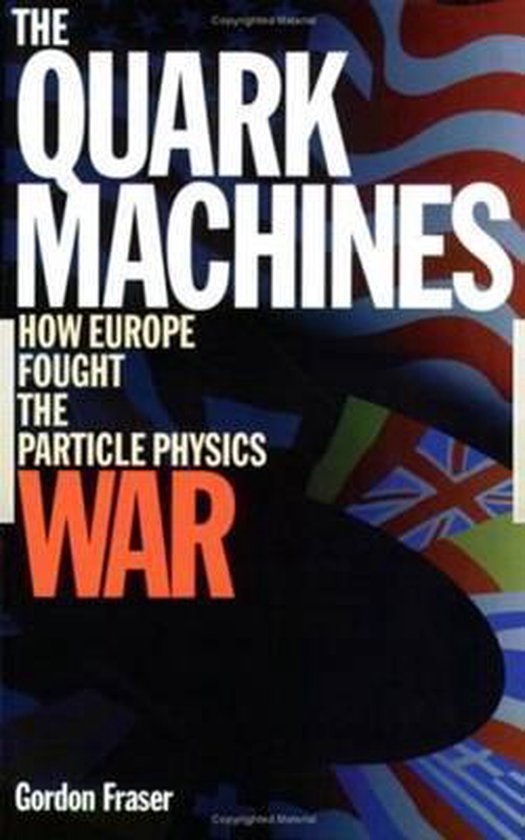
9780750304474 - The Quark Machines

The Quark Machines

'The Quark Machines' by G Fraser is a fascinating exploration of the world of particle physics, focusing on the development and operation of particle accelerators and detectors that have revolutionized our understanding of the fundamental building blocks of matter. The book takes readers on a journey from the early days of particle physics to the cutting-edge experiments at CERN and other laboratories worldwide. Fraser, a renowned science writer, explains complex concepts in an accessible way, making this book suitable for both science enthusiasts and general readers. He delves into the history of the Standard Model, the discovery of quarks, and the role of accelerators like the Large Hadron Collider in uncovering new particles. The book also discusses the technological innovations behind these machines, the international collaborations involved, and the future of particle physics. With a blend of storytelling and scientific detail, Fraser captures the excitement and challenges of exploring the subatomic world. The book is richly illustrated with diagrams, photographs, and historical images that enhance understanding. Whether you are a student, a teacher, or simply curious about the universe, 'The Quark Machines' offers an engaging and comprehensive overview of one of the most thrilling fields in modern science.

Beschikbare exemplaren

€9.95
GOED

'The Quark Machines' is an outstanding book that successfully bridges the gap between popular science and technical exposition. G Fraser has a talent for making particle physics accessible without oversimplifying. The book's greatest strength is its clear explanation of how particle accelerators work, from the basic principles to the complex engineering. The historical context is well-researched, providing fascinating insights into the key figures and discoveries. However, some sections may be dense for complete novices, particularly those dealing with quantum mechanics. The book could benefit from more diagrams to illustrate certain concepts. Despite this, the narrative flow is engaging, and Fraser's enthusiasm is contagious. The coverage of modern experiments, such as those at the LHC, is up-to-date and includes recent findings like the Higgs boson. One minor weakness is that the book occasionally assumes prior knowledge of physics terminology. Overall, 'The Quark Machines' is a valuable resource for anyone interested in the forefront of scientific research. It earns high praise for its depth, accuracy, and readability. I highly recommend it to students and enthusiasts alike.

'The Quark Machines' by G Fraser provides a comprehensive overview of particle physics and the machines that drive discovery. The book begins with the historical development of particle accelerators, from early cyclotrons to modern synchrotrons and colliders. It explains the fundamental particles of the Standard Model, including quarks, leptons, and bosons, and how accelerators are used to study them. Fraser details the inner workings of detectors, such as calorimeters and trackers, and how they capture data from collisions. The narrative then moves to key experiments that confirmed the existence of quarks and other particles, highlighting the role of accelerators like the Tevatron and the LHC. The book also covers the search for the Higgs boson and its eventual discovery, as well as ongoing research into dark matter, antimatter, and extra dimensions. Fraser discusses the technological challenges, such as superconducting magnets and vacuum systems, and the global collaborations that make these projects possible. He looks ahead to future accelerators, including the International Linear Collider and the Future Circular Collider. Throughout, the book emphasizes the human story behind the science, featuring profiles of scientists and engineers. The summary concludes with a reflection on the impact of particle physics on technology and our understanding of the universe.