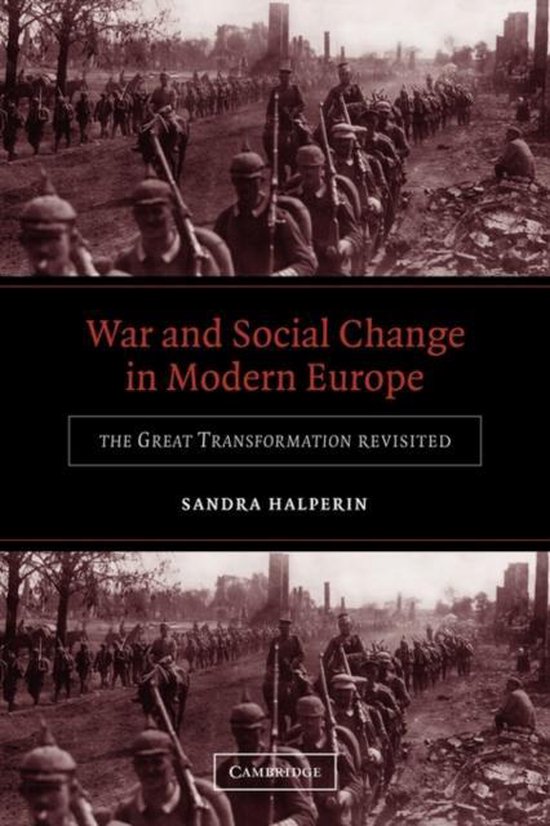
9780521540155 - War and Social Change in Modern Europe

War and Social Change in Modern Europe

War and Social Change in Modern Europe by Sandra Halperin is a profound academic exploration that delves into the intricate relationships between warfare and societal transformations across Europe from the late 18th century to the present day. This book meticulously examines how major conflicts, including the Napoleonic Wars, World Wars I and II, and the Cold War, have acted as catalysts for significant shifts in political structures, economic systems, and cultural norms. Halperin argues that war is not merely a destructive force but a pivotal driver of modernization, often accelerating processes such as industrialization, state-building, and the expansion of social rights. Through detailed case studies, the author illustrates how wartime exigencies have led to the centralization of state power, the rise of welfare states, and changes in class relations, while also highlighting the differential impacts on various social groups, including women, workers, and minorities. The narrative is enriched with historical evidence and theoretical insights, drawing from a wide range of disciplines to provide a comprehensive understanding of Europe's turbulent history. By connecting military conflicts to broader social dynamics, Halperin offers a nuanced perspective that challenges simplistic views of war as solely a breakdown of order, instead presenting it as a complex phenomenon that reshapes societies in enduring ways. This book is an essential resource for historians, sociologists, and anyone interested in the forces that have shaped contemporary Europe, making it a valuable addition to academic discussions on war, peace, and social evolution.

Beschikbare exemplaren

€15.95
GOED
Auteur Sandra Halperin
ISBN 9780521540155
Bindwijze Paperback
Tags Historical Analysis war history social change academic book modern Europe

War and Social Change in Modern Europe by Sandra Halperin receives high praise for its rigorous scholarship and insightful analysis, though it is not without its minor flaws. On the positive side, the book excels in providing a comprehensive and well-researched examination of how warfare has driven social transformations in Europe, offering a compelling argument that war serves as a critical engine for modernization. Halperin's use of diverse historical examples, from the French Revolution to the fall of the Berlin Wall, is particularly effective in illustrating her points, making complex theories accessible to a broad audience. The integration of political, economic, and social factors adds depth, and the prose is generally clear and engaging, which helps maintain reader interest throughout. However, some critics note that the book occasionally relies too heavily on Eurocentric perspectives, potentially overlooking the global dimensions of these conflicts and their impacts beyond Europe. Additionally, the dense academic style might be challenging for casual readers, as it assumes a certain level of prior knowledge in history and sociology. Despite these weaknesses, the strengths far outweigh them, with the book's ability to synthesize vast amounts of historical data into a coherent narrative being a standout feature. Overall, it is a highly recommended read for students and scholars, offering valuable insights into the interconnectedness of war and societal change, though those seeking a lighter treatment of the topic might find it demanding.

War and Social Change in Modern Europe by Sandra Halperin provides a detailed summary of how military conflicts have fundamentally altered European societies over the past two centuries. The book begins by setting the stage in the late 18th century, exploring how the Napoleonic Wars initiated processes of state consolidation and nationalism, leading to the erosion of feudal structures and the rise of modern bureaucracies. It then moves through the 19th century, examining the Crimean War and other conflicts that spurred industrialization and labor movements, ultimately contributing to the emergence of class-based societies. The narrative intensifies with World War I and II, highlighting how total warfare necessitated mass mobilization, which in turn fostered social welfare programs, expanded voting rights, and reshaped gender roles as women entered the workforce in large numbers. Post-World War II developments, including the Cold War, are analyzed for their role in dividing Europe and influencing economic policies, such as the Marshall Plan and the growth of the welfare state in Western Europe, while Eastern Europe experienced Soviet-imposed transformations. Halperin concludes by discussing the late 20th century, where the end of the Cold War led to new social dynamics, including globalization and the reconfiguration of European identity. Throughout, the book emphasizes that war acts as a crucible for social change, driving innovations in governance, economy, and culture, and leaves readers with a deeper understanding of Europe's evolution from a continent of empires to a union of nation-states.