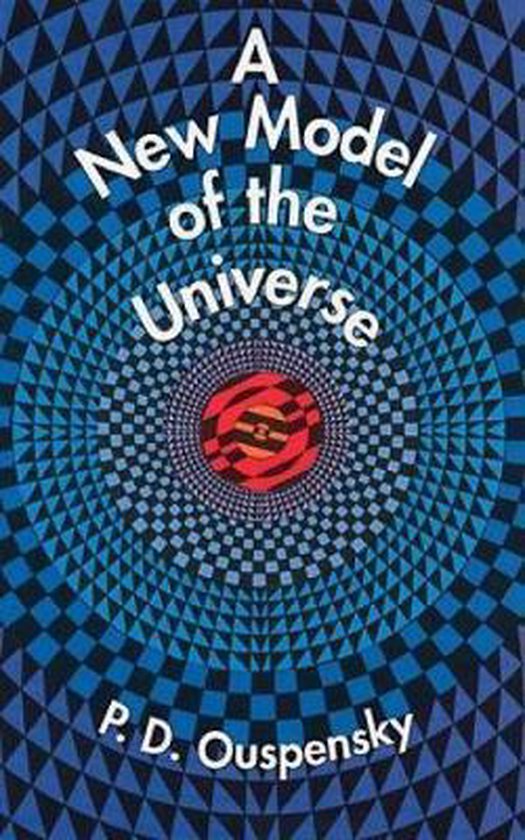
9780486297019 - A New Model of the Universe

A New Model of the Universe

In 'A New Model of the Universe' by P. D. Uspenskii, readers are invited on a profound intellectual journey that challenges conventional perceptions of reality, time, and human consciousness. Originally published in the early 20th century, this seminal work delves into esoteric philosophy, drawing from Uspenskii's deep engagement with the teachings of G.I. Gurdjieff and his own extensive research into mysticism and science. The book systematically explores themes such as the fourth dimension, the nature of time as a multi-dimensional construct, and the possibility of higher states of awareness beyond ordinary human experience. Uspenskii argues that the universe is not a static, mechanical system but a dynamic, evolving entity where consciousness plays a central role in shaping reality. He critiques materialistic science and advocates for a holistic approach that integrates spiritual insights with empirical observations, proposing that humanity can achieve a new level of understanding through disciplined self-study and inner transformation. Throughout the text, Uspenskii employs lucid prose and logical reasoning to unravel complex ideas, making abstract concepts accessible to a broad audience while maintaining scholarly rigor. This book has influenced countless thinkers in fields ranging from psychology to cosmology, and its ideas continue to resonate in contemporary discussions about consciousness and the nature of existence. By presenting a cohesive model that bridges the gap between the physical and metaphysical, Uspenskii offers a compelling vision of a universe rich with hidden dimensions and untapped potentials, encouraging readers to question their assumptions and embark on a path of personal and cosmic discovery.

Beschikbare exemplaren

€8.95
GOED
Auteur P. D. Uspenskii
ISBN 9780486297019
Bindwijze Paperback
Tags metaphysics esoteric philosophy consciousness studies Gurdjieff teachings fourth dimension

P. D. Uspenskii's 'A New Model of the Universe' is a groundbreaking work that masterfully blends esoteric philosophy with scientific inquiry, offering readers a thought-provoking exploration of reality's deeper layers. One of its strongest points is the author's ability to synthesize diverse disciplines, from mathematics and physics to mysticism, into a coherent and persuasive argument for a multi-dimensional universe. Uspenskii's writing is both eloquent and precise, making complex ideas like the fourth dimension and eternal recurrence accessible without oversimplification, which enhances the book's appeal to both novice and expert readers. Additionally, the emphasis on personal transformation and self-awareness provides practical insights that can inspire meaningful life changes, fostering a sense of empowerment and intellectual curiosity. However, the book has its weaknesses; some critics argue that Uspenskii's reliance on Gurdjieff's teachings may come across as dogmatic or speculative, lacking rigorous empirical evidence in certain sections, which could deter readers seeking strictly scientific validation. The dense, philosophical nature of the text might also pose a challenge for those unfamiliar with esoteric concepts, potentially leading to confusion or disengagement if not approached with patience. Despite these drawbacks, the work's enduring relevance and its ability to stimulate deep reflection on consciousness and existence make it a valuable addition to any library, particularly for those interested in alternative worldviews and spiritual growth. Overall, while it may not satisfy all skeptics, its strengths in fostering intellectual expansion and personal insight far outweigh its limitations, cementing its status as a classic in metaphysical literature.

'A New Model of the Universe' by P. D. Uspenskii presents a comprehensive reevaluation of cosmic and human reality, arguing that the universe is far more complex and interconnected than traditional science suggests. The book begins by critiquing the limitations of materialistic worldviews, then delves into the concept of the fourth dimension, illustrating how it can explain phenomena beyond three-dimensional perception. Uspenskii explores the nature of time, proposing it as a cyclical or multi-layered entity rather than a linear progression, and discusses how human consciousness can access higher states of awareness through disciplined practices. He integrates ideas from esoteric traditions, such as the teachings of Gurdjieff, to suggest that individuals can achieve self-realization by understanding their place in a vast, evolving cosmos. The narrative weaves together themes of eternity, recurrence, and the potential for inner transformation, culminating in a vision where humanity plays an active role in cosmic evolution. Throughout, Uspenskii uses analogies from mathematics and physics to clarify abstract notions, making the text both educational and inspirational. The story unfolds as a philosophical journey, encouraging readers to question their perceptions and embrace a more holistic understanding of existence, ultimately aiming to bridge the gap between the mundane and the mystical for a fuller, more enlightened life.