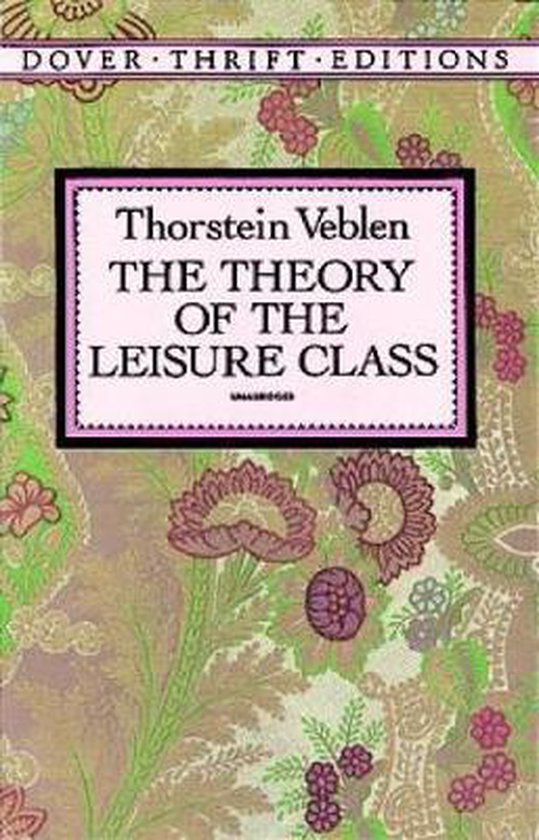
9780486280622 - Theory Of The Leisure Class

Theory Of The Leisure Class

Thorstein Veblen's 'Theory of the Leisure Class' is a seminal work in economics and sociology, first published in 1899. In this incisive critique, Veblen introduces the concept of 'conspicuous consumption'—the practice of purchasing goods and services to display wealth rather than to fulfill genuine needs. He argues that the leisure class, which emerged from primitive tribal societies, sets the standards for social status through wasteful expenditure and ostentatious displays of affluence. Veblen traces the evolution of this class from feudal times to the industrial age, showing how their habits and values permeate all levels of society. The book challenges the classical economic assumption that consumption is driven solely by utility, highlighting instead the role of social competition and emulation. Veblen's sharp wit and penetrating analysis expose the absurdities of a system where people strive to outdo each other in material possessions, often at the expense of genuine well-being. He also examines the role of women as status symbols, the rise of sports and fashion as arenas for conspicuous display, and the persistence of archaic tastes in modern society. This edition, published by Dover Publications, includes the complete original text and is part of their thrift editions series, making it accessible to a wide audience. 'Theory of the Leisure Class' remains highly relevant today, offering profound insights into consumer culture, inequality, and the social dynamics of wealth. It is essential reading for anyone interested in understanding the roots of modern consumerism and the psychological drivers behind our spending habits.


Beschikbare exemplaren

€13.95
REDELIJK
Auteur Thorstein Veblen
ISBN 9780486280622
Bindwijze Paperback
Tags sociology Economics conspicuous consumption consumer culture social class

'Theory of the Leisure Class' is a groundbreaking work that remains as insightful today as it was over a century ago. Veblen's concept of conspicuous consumption is a powerful lens through which to view modern consumer culture. The book's strength lies in its sharp social commentary and satire, dissecting the motivations behind our spending and status-seeking behaviors. Veblen's writing is dense and academic, which can be challenging for casual readers, but his wit and clarity make the effort worthwhile. The book effectively argues that economic behavior is not purely rational but deeply influenced by social pressures and the desire for prestige. However, some may find the prose dated and the arguments repetitive at times. Veblen's focus on the leisure class, primarily the wealthy elite, may seem narrow, but he convincingly shows how their values trickle down to all social strata. The book lacks empirical data by modern standards, relying more on anecdotal evidence and theoretical reasoning. Nonetheless, its core ideas have influenced fields from economics to marketing. This Dover edition is affordable and well-formatted, making it a great entry point for students and general readers. I highly recommend this classic to anyone seeking to understand the underlying drivers of consumerism and social inequality. It will change how you view your own purchasing decisions and the society around you.

In 'Theory of the Leisure Class', Thorstein Veblen explores the social and economic behaviors of the wealthy elite, whom he terms the 'leisure class'. He argues that this class, which originated in primitive societies where property and status were linked, continues to shape modern consumption patterns. The book introduces the idea of conspicuous consumption: spending money on luxury goods and services to signal social status. Veblen explains that the leisure class engages in 'conspicuous leisure'—activities that demonstrate their freedom from productive work—and 'conspicuous waste'—spending on unnecessary items to display wealth. These practices are not merely personal choices but are driven by social competition and the desire for reputability. Veblen also discusses the role of women as 'vicarious consumers', whose consumption reflects their husband's status. He examines how these dynamics influence fashion, sports, religion, and education, arguing that many modern institutions perpetuate wasteful displays. The book critiques classical economics for ignoring these social factors, and it offers a scathing commentary on the irrationality of a system that values appearance over substance. Veblen's analysis extends to the 'industrial' and 'pecuniary' employments, distinguishing between productive work and activities that merely manipulate wealth. He concludes that the leisure class's values are at odds with the efficiency and productivity of modern industry. The book remains a powerful critique of consumerism and a foundational text in institutional economics.