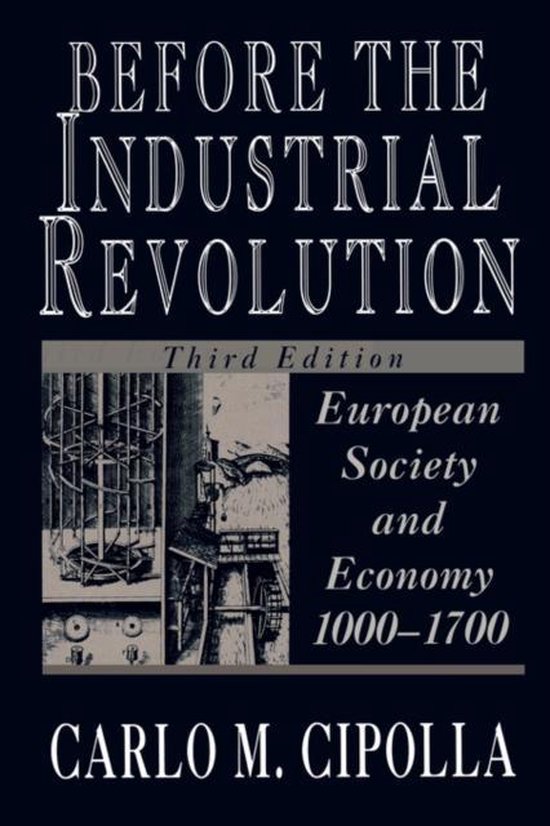
9780393311983 - Before The Industrial Revolution

Before The Industrial Revolution

In Before The Industrial Revolution, Carlo M. Cipolla presents a masterful analysis of European society and economy from the Middle Ages to the dawn of industrialization. This seminal work explores the intricate dynamics of pre-industrial Europe, examining how demographic patterns, agricultural practices, trade networks, and technological innovations shaped a world that was both familiar and alien to modern readers. Cipolla delves into the social structures, from peasant life to urban merchant classes, and the economic systems that relied on organic energy sources like wood, wind, and water. He highlights the limitations of a civilization dependent on animate power and the fragile balance between population and resources. The book also addresses the cultural and institutional frameworks that fostered or hindered economic growth, including guilds, banking, and state formation. Cipolla's narrative is enriched with vivid examples, from the bustling ports of Venice to the rural landscapes of France, illustrating how local conditions converged to create a unique European path. Crucially, he debunks myths about the 'Dark Ages' and reveals the dynamic changes that paved the way for the Industrial Revolution. This comprehensive overview not only explains the economic history but also connects it to broader social and intellectual currents, making it an essential read for historians, economists, and anyone curious about the roots of modern society. Cipolla's clear, engaging prose transforms complex data into a compelling story of human adaptation and innovation. With its meticulous research and insightful analysis, Before The Industrial Revolution remains a classic that illuminates the foundations of our contemporary world.

Beschikbare exemplaren

€7.95
GOED
Naam op voorblad. Verder is het boek in prima staat.

Auteur Carlo M. Cipolla
ISBN 9780393311983
Bindwijze Paperback
Tags economic history social history industrial revolution pre-industrial Europe Carlo Cipolla

Carlo M. Cipolla's Before The Industrial Revolution is a brilliant synthesis of economic history that has stood the test of time. The book's greatest strength is its ability to make complex economic concepts accessible without oversimplification. Cipolla masterfully weaves demographic data, agricultural yields, and trade statistics into a coherent narrative that explains how pre-industrial Europe functioned and why it eventually transformed. His analysis of the 'Malthusian trap' and the role of energy constraints is particularly insightful, offering a clear framework for understanding the limitations of pre-modern economies. The book is also commendable for its breadth, covering not only economic factors but also social structures, technology, and cultural attitudes. However, some readers may find the writing dense and data-heavy, as Cipolla often prioritizes factual detail over narrative flair. Additionally, the book's focus on Western Europe means that other regions receive less attention, which might limit its comparative value. The lack of a strong central thesis can also make the text feel somewhat fragmented, as it moves from topic to topic without always tying them together. Despite these minor flaws, Before The Industrial Revolution is an indispensable resource for anyone seeking a deep understanding of the pre-industrial world. Cipolla's expertise and clarity shine through, making even the most intricate economic principles understandable. For students and scholars alike, this book remains a foundational text that continues to inform current debates about economic development and societal change. Its enduring relevance is a testament to Cipolla's skill as a historian and writer.

Before The Industrial Revolution by Carlo M. Cipolla provides a comprehensive overview of European economic and social history from roughly 1000 to 1700 AD. The book is divided into four parts, each focusing on a key aspect of pre-industrial society. Part One examines the demographic and economic framework, highlighting the slow population growth, high mortality rates, and the dominance of agriculture. Cipolla explains how most people lived in rural communities, subsistence farming was the norm, and trade was limited to luxury goods. Part Two delves into the sources of energy and technology, describing how pre-industrial societies relied on organic energy sources such as wood, wind, water, and animal power. The author discusses the limitations of these energy sources and how they constrained economic growth. Part Three explores the social structure, including the roles of peasants, artisans, merchants, and the nobility. Cipolla analyzes the feudal system, the rise of towns, and the development of guilds and early capitalist institutions. Part Four focuses on the economic policies and institutions of the time, such as mercantilism, banking, and state formation. The book concludes with a discussion of the factors that eventually led to the Industrial Revolution, including technological innovations, changes in agriculture, and the expansion of trade. Throughout, Cipolla emphasizes the interconnectedness of demographic, economic, social, and technological factors, painting a holistic picture of a world in transition. The narrative is supported by extensive data, tables, and examples from various European regions, making it both informative and engaging. This summary captures the essence of a work that remains a cornerstone in economic history literature.