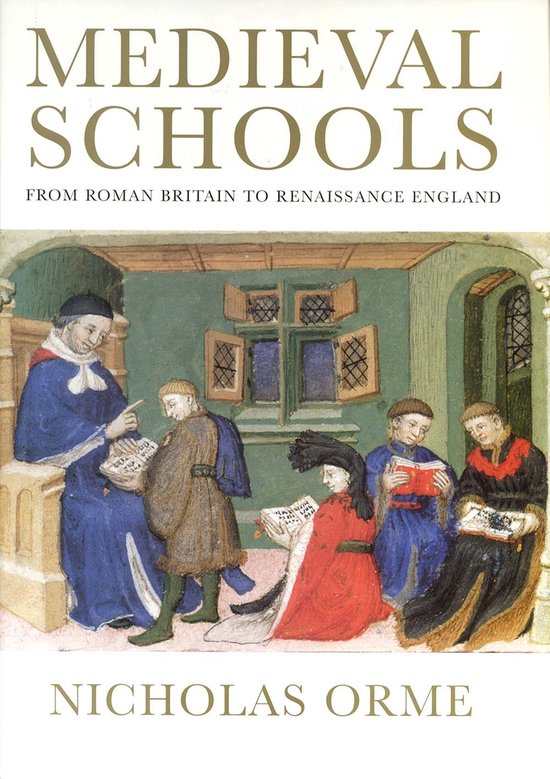
9780300111026 - Medieval Schools - From Roman Britain to Tudor England

Medieval Schools - From Roman Britain to Tudor England

In 'Medieval Schools: From Roman Britain to Tudor England', Nicholas Orme presents a comprehensive and meticulously researched history of education in England from the Roman era to the Reformation. The book explores the development of schools, curricula, and the role of education in society, covering a period of over a thousand years. Orme examines how schools were established by churches, monasteries, and towns, and how they evolved from informal arrangements to more structured institutions. He delves into the subjects taught, including Latin, grammar, and arithmetic, and discusses the lives of teachers and students, from the wealthy elite to the poor. The book also considers the impact of political and religious changes, such as the Norman Conquest and the dissolution of the monasteries, on educational practices. Orme challenges the common assumption that medieval education was solely religious, highlighting the practical and vocational aspects of schooling. He provides detailed accounts of specific schools, including cathedral schools, chantry schools, and early grammar schools, and traces the origins of famous institutions like Eton and Winchester. The book is richly illustrated with maps, diagrams, and images of manuscripts, offering a visual dimension to the narrative. Orme's scholarship is rigorous, drawing on a wide range of primary sources, including school statutes, textbooks, and student records. This work is essential reading for historians of education and anyone interested in the medieval period. It fills a significant gap in the historiography, providing a nuanced understanding of how education functioned in a pre-modern society. The book concludes with the Tudor period, showing how the Reformation brought both disruption and renewal to English schooling. Overall, 'Medieval Schools' is a masterful synthesis that brings to life the world of medieval education.

Beschikbare exemplaren

€15.95
GOED
Auteur Nicholas Orme
ISBN 9780300111026
Bindwijze Hardcover
Tags medieval education Nicholas Orme English history schooling in the Middle Ages

Nicholas Orme's 'Medieval Schools' is a landmark study that offers an unparalleled depth of insight into the history of education in England. The book's greatest strength lies in its comprehensive scope, covering over a millennium of educational development. Orme's meticulous research is evident on every page, with a wealth of primary sources that bring the subject to life. He successfully challenges the misconception that medieval education was solely religious, revealing a system that was practical and diverse. The inclusion of maps, illustrations, and manuscript images enhances the reader's understanding. However, the book's dense academic style may be challenging for casual readers. The sheer volume of detail can sometimes overwhelm, and the narrative occasionally becomes bogged down in minutiae. Additionally, the focus remains almost exclusively on England, with little comparative perspective from other European countries. Orme's treatment of gender is also limited; while he acknowledges the education of girls, it is not explored in depth. Despite these minor shortcomings, 'Medieval Schools' is an indispensable resource for historians. It effectively bridges the gap between Roman and Tudor education, a period often neglected in historical studies. The book's final chapters on the Reformation provide a compelling conclusion, showing how religious upheaval transformed schooling. For those with a serious interest in medieval history or the origins of modern education, this book is a must-read. It is a scholarly achievement that will remain a standard reference for years to come.

'Medieval Schools: From Roman Britain to Tudor England' by Nicholas Orme traces the evolution of education in England from the departure of Roman legions to the reign of Henry VIII. The book begins by examining the sparse evidence for schools in Roman Britain and the early medieval period, highlighting the role of monasteries in preserving learning. As Christianity spread, cathedral and monastic schools emerged, teaching Latin for religious purposes. The Norman Conquest brought continental influences, leading to the establishment of more formal grammar schools. Orme discusses the curriculum, which centered on the trivium and quadrivium, and the daily life of students, who often faced strict discipline. The 12th and 13th centuries saw the rise of universities, but Orme focuses on primary and secondary education, including the founding of chantry schools by wealthy patrons. He also explores the education of girls, primarily in nunneries or at home. The Black Death and subsequent labor shortages affected school attendance, but the 15th century witnessed a renaissance in schooling, with new foundations like Winchester College and Eton. The book details the impact of the Reformation, as Henry VIII's dissolution of monasteries and chantries disrupted existing schools, but also led to the creation of new ones under royal and civic control. Orme concludes by assessing the legacy of medieval education, arguing that it laid the groundwork for modern systems. Throughout, he emphasizes that schools were not just for clerics but for lay people seeking literacy for commerce and administration. The narrative is enriched with case studies of individual schools and educators, providing a vivid picture of teaching and learning in the Middle Ages.