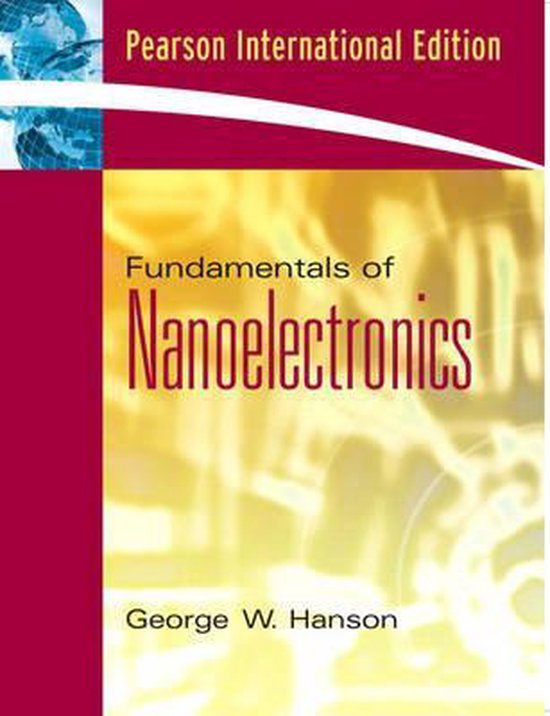
9780131588837 - Fundamentals of Nanoelectronics

Fundamentals of Nanoelectronics

Fundamentals of Nanoelectronics by George W. Hanson is a comprehensive textbook that delves into the principles and applications of nanoelectronics, a field at the forefront of modern technology. This book is designed for graduate and senior undergraduate students in electrical engineering, physics, and related disciplines, providing a solid foundation in the physics of nanoscale electronic devices. The text covers essential topics such as quantum mechanics, solid-state physics, and electromagnetism, all tailored to the nanoscale regime. It explores the behavior of electrons in confined structures, including quantum wells, wires, and dots, and discusses transport phenomena like ballistic transport, tunneling, and Coulomb blockade. The book also addresses practical device concepts such as single-electron transistors, resonant tunneling diodes, and nanoscale MOSFETs. With a focus on both theoretical understanding and practical applications, Hanson integrates mathematical derivations with physical insights, making complex concepts accessible. The inclusion of numerous examples, end-of-chapter problems, and references to original research helps reinforce learning. This textbook is an invaluable resource for anyone seeking to understand the fundamental physics that governs nanoelectronic devices, preparing readers for advanced study or research in nanotechnology. Its clear exposition and rigorous treatment make it a staple in the field.

Beschikbare exemplaren

€26.95
GOED
Auteur George W. Hanson
ISBN 9780131588837
Bindwijze Paperback
Tags quantum mechanics solid-state physics nanoelectronics nanoscale devices George W. Hanson

George W. Hanson's Fundamentals of Nanoelectronics is a well-crafted textbook that offers a thorough introduction to the physics underlying nanoscale electronic devices. One of its greatest strengths is the clear and logical progression from fundamental quantum mechanical concepts to advanced topics like quantum transport and nanoscale device modeling. The mathematical treatments are rigorous yet accompanied by intuitive explanations, which helps demystify complex phenomena. The book also includes a wealth of practical examples and problems that effectively bridge theory and application. However, the text assumes a solid background in electromagnetics and quantum mechanics, which might be challenging for some readers. Additionally, while the coverage is broad, some topics like spintronics and molecular electronics are only briefly touched upon. The writing style is academic and dense, which may not suit all learning preferences. Despite these minor drawbacks, the book excels as a reference for graduate students and researchers. Its comprehensive appendices and extensive bibliography further enhance its utility. Overall, Fundamentals of Nanoelectronics is a highly recommended resource for those seeking a deep understanding of nanoelectronics, though it requires commitment and prior knowledge to fully benefit from its content.

Fundamentals of Nanoelectronics by George W. Hanson provides a systematic exploration of the physical principles that govern electronic devices at the nanoscale. The book begins with a review of essential quantum mechanics, including wave-particle duality, the Schrödinger equation, and the concept of quantum states. It then introduces solid-state physics concepts such as crystal structures, band theory, and effective mass approximation, adapted for nanoscale systems. A significant portion of the text is devoted to the behavior of electrons in low-dimensional structures—quantum wells, wires, and dots—where quantum confinement effects dominate. The book examines various transport mechanisms, including diffusive and ballistic transport, and discusses phenomena like resonant tunneling, Coulomb blockade, and the quantum Hall effect. Practical device applications are covered in detail, with chapters on single-electron transistors, resonant tunneling diodes, and nanoscale field-effect transistors. The text also addresses the challenges of modeling and simulating nanoscale devices, emphasizing the importance of quantum corrections to classical models. Throughout, Hanson integrates theoretical derivations with real-world examples, highlighting the connection between fundamental physics and device performance. The book concludes with a look at emerging technologies and future directions in nanoelectronics. This summary encapsulates the key topics covered, providing a roadmap for understanding the complex interplay between quantum mechanics and electronic device engineering at the nanoscale.